Is Your Offset Account Actually Costing You Money?
Most Australians are told the same thing: always get a home loan with an offset account. It is the single most repeated piece of advice on every comparison site, broker blog, and finance subreddit. But for a significant percentage of borrowers, this advice is wrong.
We track home loans from Australian lenders, including which products offer offset accounts and what they cost. Below, we break down exactly when an offset account saves you money – and when it quietly drains it.
The Advice Everyone Gives
Search "should I get an offset account" and you will find dozens of articles telling you the same thing: yes, always. The logic sounds bulletproof:
- Money in your offset account reduces the principal your interest is calculated on.
- You pay less interest each month.
- You pay off your loan sooner.
That is all true – in isolation. But it ignores the cost of accessing an offset account in the first place.
The Two Hidden Costs No One Talks About
1. The Rate Premium
Loans with offset accounts are almost never the cheapest on the market. Lenders price the offset functionality into the rate. A "basic" or "no-frills" variable rate loan – one without an offset account – typically offers a rate that is 0.10% to 0.25% p.a. lower than the equivalent offset-eligible product from the same lender.
The best basic variable rate right now is 5.43% p.a.. Offset-eligible loans from the same lenders are typically higher.
2. The Annual Package Fee
Many offset-eligible loans sit inside a "home loan package" that charges an annual fee, commonly $295 to $395 per year. Basic variable loans almost never charge package fees.
Together, these two costs create a breakeven balance – the minimum amount you must keep in your offset account at all times for the interest savings to outweigh the extra costs.
The Breakeven Calculation
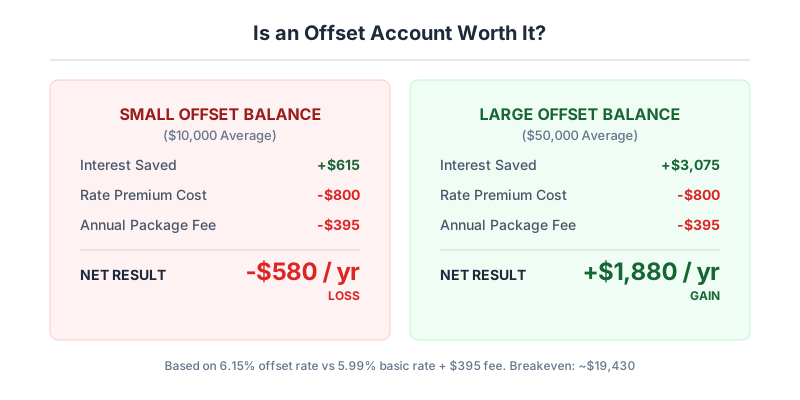
This is the number your broker should be providing, but almost never does.
The Formula
Breakeven Balance = (Annual Fee + (Rate Premium x Loan Balance)) / Offset-Eligible Rate
Worked Example
Consider a borrower with a $500,000 home loan:
| Basic Variable | Offset Package | |
|---|---|---|
| Interest rate | 5.99% p.a. | 6.15% p.a. (+0.16%) |
| Annual package fee | $0 | $395 |
| Extra annual cost | - | $1,195 |
The rate premium alone costs $800 per year ($500,000 x 0.16%). Add the $395 annual fee and the offset package costs $1,195 per year more than the basic loan.
To break even, the borrower must maintain an offset balance that saves at least $1,195 in interest:
$1,195 / 0.0615 = ~$19,430 minimum offset balance at ALL times
Where Most Australians Actually Stand
Here is the uncomfortable truth. ABS data shows the median Australian savings balance is approximately $10,000 to $15,000. If your offset balance sits at $10,000:
| Calculation | Result | |
|---|---|---|
| Interest saved by offset | $10,000 x 6.15% | $615 per year |
| Extra cost of offset loan | Rate premium + fee | $1,195 per year |
| Net result | $615 - $1,195 | -$580 per year LOSS |
Over a 30-year loan, that is $17,400 lost by following the "best practice" advice.
⚠️ The median Australian borrower would be better off on a basic variable rate with no offset account.
When an Offset Account IS Worth It
We are not saying offset accounts are bad. They are a powerful tool – for the right borrower. An offset account is clearly worth it if:
- Your offset balance consistently exceeds the breakeven threshold (typically $15,000 to $25,000+)
- You use the offset account as your primary transaction account (salary credited, everyday spending)
- You are building savings toward a goal (renovation, investment deposit) and want to keep the money accessible
- You have irregular income (self-employed, contractors) and maintain larger cash buffers
The Sweet Spot
The larger your offset balance relative to your loan, the more you save. For borrowers who keep $50,000+ in their offset, the interest savings can reach $2,000 to $3,000 per year – well above the breakeven point.
How to Check If YOUR Offset Is Worth It
Step 1: Find your basic rate alternative
Ask your lender (or check on RatePilot): What is the cheapest variable rate you offer WITHOUT an offset account? Compare this to your current offset-eligible rate. For tips on what to look for, see our how to choose a home loan guide.
Step 2: Calculate the annual cost difference
Extra cost = (Rate premium x Your loan balance) + Annual package fee
Step 3: Calculate your interest saving
Interest saved = Average offset balance x Your offset-eligible rate
Step 4: Compare
If your interest saved is greater than your extra cost, keep the offset. If not, consider switching to a basic variable loan.
Use our Offset Simulator to run this calculation with your exact numbers and see a month-by-month comparison.
What About Redraw Instead?
For a detailed comparison of offset accounts and redraw facilities, read our offset account vs redraw facility guide.
Some basic variable loans offer a redraw facility instead of an offset. Redraw lets you make extra repayments and withdraw them later.
| Feature | Offset Account | Redraw Facility |
|---|---|---|
| Interest benefit | Yes - dollar for dollar | Yes - dollar for dollar |
| Access to funds | Instant (linked transaction account) | Usually 1-2 business days |
| Rate premium | Typically yes | Typically no |
| Package fee | Often required | Usually not required |
| Tax treatment | More favourable for investors | Can create tax complications for investors |
| Minimum withdrawal | No minimum (it is your everyday account) | Often $500+ minimum |
For owner-occupiers who do not need instant access to their surplus funds, redraw on a basic variable loan may deliver the same interest savings at a lower total cost.
Important for investors: If you are borrowing to invest, the tax treatment of offset vs redraw can differ significantly. An offset account generally preserves the tax deductibility of your loan interest, while redraw may not. Seek professional tax advice for your specific situation. Our investment property loan guide covers this topic in more detail.
The RBA Cash Rate Connection
The current RBA cash rate sits at 3.85%. When the cash rate is higher, the interest savings from an offset account are worth more in dollar terms – but so is the rate premium on the offset loan. The breakeven balance does not change dramatically with rate movements, because both the cost and the benefit scale proportionally.
What does change is the cost of doing nothing. In a higher-rate environment, every dollar of unnecessary interest hurts more. This is exactly the time to check whether your loan structure is optimised.
Keep an eye on the RBA cash rate for the latest movements. If you are considering refinancing to a basic rate, our how to refinance your home loan guide walks you through the process.
A Decision Framework
Use this simple flowchart to decide:
- What is the rate difference between the cheapest basic variable and your offset-eligible rate? (Check at RatePilot)
- What is the annual package fee on the offset-eligible loan?
- What is your realistic average offset balance? Be honest – use the last 12 months, not your best month.
- Run the breakeven calculation above or use our Offset Simulator.
| Your average offset balance | Likely verdict |
|---|---|
| Below $10,000 | Basic variable is almost certainly cheaper |
| $10,000 - $20,000 | Marginal - run the exact numbers |
| $20,000 - $40,000 | Offset is likely worth it, but verify |
| Above $40,000 | Offset account is clearly beneficial |
Compare Home Loans on RatePilot
Ready to check whether a basic variable loan could save you money? Compare home loans and filter by offset, redraw, and rate type to find the best structure for your situation.
| Lender | Product | Rate | Comparison | Features |
|---|---|---|---|---|
 Bank of China Bank of China | Discount Home Loan (With Principal And Interest Repayment) (Variable) | 5.43% | 5.64% | RedrawExtra |
| Bank of China | Discount Plus Home Loan (With Principal And Interest Repayment) (Variable) | 5.43% | 5.82% | OffsetRedrawExtra |
| Up Home Loan (Variable) | 5.45% | 5.45% | OffsetRedrawExtra | |
| Home Value Loan (Variable) | 5.49% | 5.50% | RedrawExtra | |
| Home Value Loan (Variable) | 5.54% | 5.55% | RedrawExtra | |
 ME Bank ME Bank | Me Bank Econome Home Loan (Variable) | 5.58% | 5.60% | RedrawExtra |
The best variable rates right now start from 5.43% p.a.. Compare offset-eligible and basic rates side by side to see the true cost difference.
Frequently Asked Questions
Put your knowledge into action
Now that you understand the detail, compare your options.